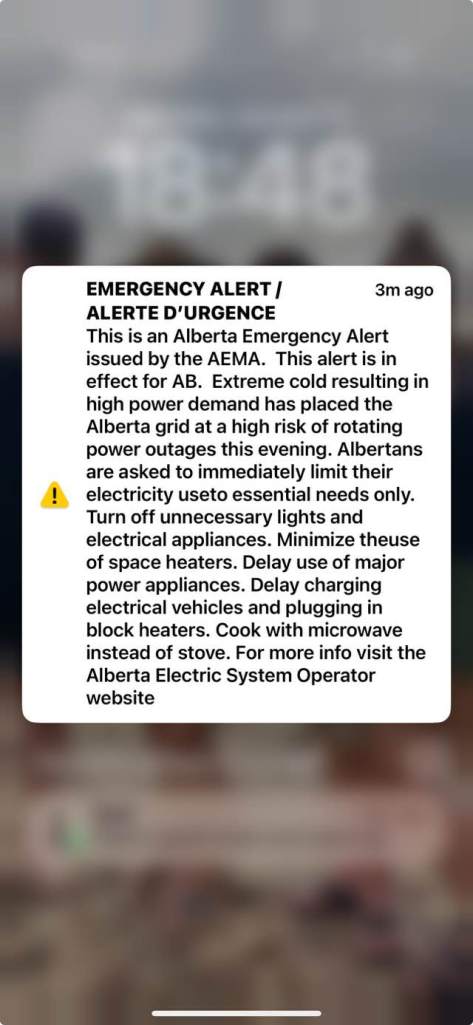
In January 2024, Arctic cold blanketed much of North America, which led to a conversation on social media about a failing electricity grid, that threatens to divide the owners of fossil fuel cars (or ICE – short for internal combustion engines) and electric vehicles (EV) in Alberta and elsewhere where oil is king.
Albertans love their big 4×4 gas trucks, so it is not surprising the current Premier of Alberta is cautioning people with electric vehicles to refrain from charging their EVs, and other use of electricity during this time because they say it is overly stressful on their failing electrical grid. Most EVs are charged at night at any rate, and the number of owners are small, so that logic is suspect.
First, I admit I am biased, as a member of a household with two electric vehicles and living in a rural area that often loses electricity because of inclement weather. We are fully aware how the cold impacts electricity and our EVs. The problem, I believe, is greater than just unplugging our electric vehicles or appliances.
Secondly, we ultimately must STOP electing anti-green anti-renewable energy government who are if not completely climate deniers, underfund investments in alternative energy and continue to subsidize the oil and gas industry.
That said, we are in an era where we must stop living in the fossil fuel driven past and come up with an alternative to oil and gas. An EV is just one option.
Indeed, we do not (yet) have the infrastructure to convert all gas cars to EVs, but we must contemplate switching to greener energy, it will take time for sure and there will be some challenges along the way. Can we do it by 2035? I believe we can.
Yes, Oil and gas have provided us with a comfortable living for the past 100 years or so, but the question remains is: it the only way to earn a living? Or to drive?
On a recent episode of Empathetic Witness Podcast with Angelina, I put a question to a Lakota First Nation elder how we reconcile the need to work in the oil industry for our livelihood and our concern for the environment.
His answer surprised me. He said that we don’t, and the two just can’t be reconciled. In other words, he said, find another way to earn a living that does not degrade Mother Earth, because it is our ethical obligation to leave the integrity of the Earth whole for the next seven generations. I can understand as an Indigenous person what he is saying. I built a career on the protection of Treaty and Aboriginal Rights to correct historical wrongs of the Canadian Federal government to usurp the territories of Indigenous peoples for the resources like oil and gas, I could have as easily worked for the Government, but I chose not to. I choose to not compromise my Indigenous relationship with Mother Earth for the sake of making a dollar.
In addition to harm to the Earth, think about what fossil fuel consumption is doing to our atmosphere and the heating of our world. We cannot sustain our reliance on oil and gas because the ecological cost is too great. And undoubtedly, we can expect to be experiencing more extreme climate events that will impact the electricity grid. Extreme weather includes unprecedented forest fires that impacts the world globally.
I leave it to you what you do individually to make our government consider green energy. I believe, subsidizing the auto industry that want to build universal electrical charging stations across Canada on the trans-Canada highway for EVs a start. At the same time, I hold no illusions that An EV will save our planet. There are issues with EV, mainly, mining for lithium batteries. Lithium mining is about to become a real issue in the Northwest Territories where some of our clients live. Having said this, EV manufacturers are trying to develop better battery components to minimize the use of lithium.
 From the Shores of the Ottawa River
Leave a comment