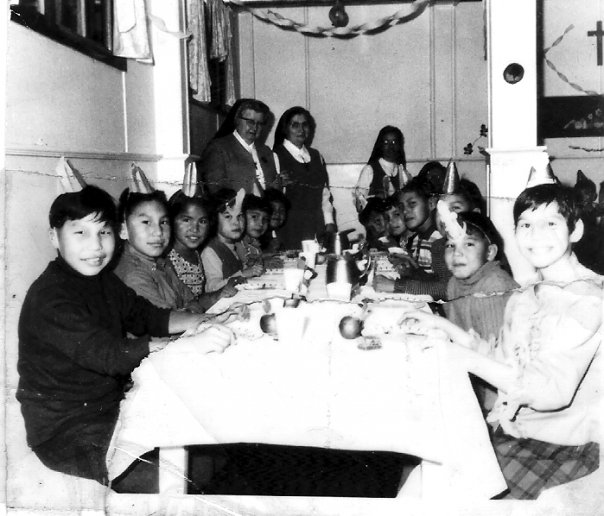
I am part of the last generation of survivors of a dark chapter in Canadian history—the Indian residential schools. But I am more than a survivor; I am resilient, and brave.
In the summer of 2022, Pope Francis visited Canada. He came to apologize for the Roman Catholic Church’s role in residential schools. His visit stirred deep emotions and reopened old wounds. It made me think about the stories we tell—so often centered on trauma, pain, and loss. But what about our strength? Our resilience? The courage that carried us onward despite everything. Some people say we should just move on. But how do we do that? How do we do that when our perspective was shaped by the oppressive experience of residential school. It was not our fault.
I spent seven years at Holy Angels Residential School, in Fort Chipewyan, Alberta.
I want my children, grandchildren, and great-grandchildren to know that I was strong. As a child, I was curious and loved to learn. I read any book I could find. In my early years, it was Christianity and stories of martyrs. As a teenager, I was drawn to mysticism and witchcraft. As an adult, I devoured biographies, nonfiction, and fiction alike. My love of learning never faded.
Oppression is not just something that happens to us. It stays within us and shapes the way we see ourselves. It influences the world around us. It is a weight we carry, sometimes without even realizing it, passed down through generations like an unseen chain. The trauma of residential schools did not end when the doors were shut for the last time. It lingered in the silence of families who didn’t know how to talk about their pain. It lived in the shame imposed on us. This made us question our worth. It made us doubt our identity and our place in this world.
You grow up in a system designed to strip away your culture, your language, and your sense of self. That loss doesn’t disappear overnight. It becomes part of you, woven into your thoughts and behaviors. You second-guess yourself. You feel like you’re not good enough. You hesitate to take up space, to speak up, to believe in your own strength.
That is the insidious nature of oppression. It teaches you to police yourself. You shrink and silence your own voice before anyone else has the chance to do it for you. Even when the physical oppression is gone, the mental and emotional scars stay.
For many survivors, the pain manifested in cycles of addiction, self-doubt, and feelings of unworthiness. My own brothers carried their trauma in different ways. They used humor. They became isolated. They held a relentless belief that they were not enough. I did not turn to alcohol. Yet, I still carried the weight of those unspoken wounds. I felt them in the way I moved through the world.
Many survivors turned to alcohol and drugs to cope with their pain. I never did. I can’t pinpoint the exact moment I decided not to drink, but I know this: I am stubborn. Peer pressure never swayed me. I saw firsthand the impact of drinking in my childhood, and I knew it had no place in my life.
Residential schools were the perfect storm for trauma. Vulnerable children were taken from their families. They were controlled by a system designed to erase our culture.
Yet, I do not believe I was broken. Maybe it was because, as the youngest girl in my family, with ten brothers I had a diplomatic nature. I didn’t push boundaries.
My brothers, though, suffered deeply. Rossi masked his pain with jokes and alcohol. Patrick had success as an auditor for Golf Canada. Despite this achievement, he always felt like he wasn’t good enough next to non-Indigenous people. Maxi never married, believing he was unworthy of love.
Still, even in the hardest times, resilience shone through.
I remember the first time I stood up to a nun. She slapped me hard, the sound echoing in the room. But I didn’t cry. I just stared at her. She told me I couldn’t watch the movie that night as punishment. But I knew I would. And I did. When the movie started, I silently crept down from the fourth-floor dormitory, sat on the last step, and watched. When the students clapped at the end, I ran back to bed, victorious.
As humans, we often focus on the negatives. It’s part of our survival instinct. Our brains are wired to detect threats. They remember pain so we can avoid it in the future. But in today’s world, that instinct works against us. Instead of helping us survive, it keeps us trapped in our suffering. We replay the worst moments of our lives, reliving the pain over and over. We tell stories of what hurt us, what broke us, what made us feel small.
But what if we changed that?
If you are a former residential school student, I invite you to seek out the moments of your resilience. Please share these moments. These are the stories we must tell—stories of triumph, strength, and courage.
Yes, there was pain, but there was also joy. Sunday night movies, bingo games, weekend trips to the lake, running freely on the hills.
We choose the stories we tell. Will they be stories of suffering, or stories of strength? That choice is ours.
And it’s not just about residential school. Think of any childhood challenge—where did you find resilience? Tell that story. Make it a habit to find strength in yourself. Too often, we focus on what upset us. We must train ourselves to recognize our power instead.
Speak up when you feel you are disrespected—kindly, but firmly. Own your story.
In my podcast, Empathic Witness, I seek out stories of resilience, bravery, and tenacity. We must never forget the horrors, but we must also frame our stories in ways that set us free.
That was like the moment when the nun slapped me. I tell it not as a story of pain. I share it as a moment where I reclaimed my power. I did not let her punishment define me.
When I share that story, I feel brave.
And I hope that by sharing it, you will see your own bravery too. Remember if you can still speak your Indigenous language you’re braver than you think.
 From the Shores of the Ottawa River
Leave a comment