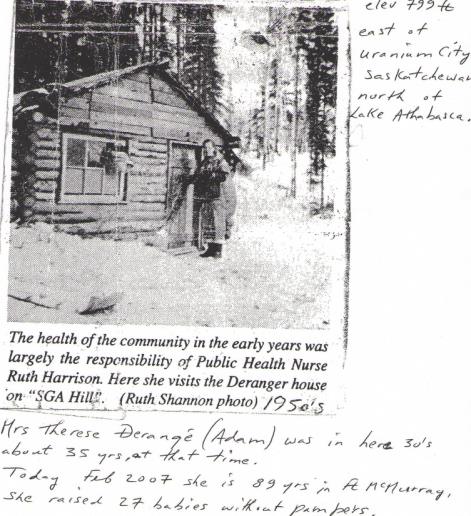
Mama, whose full name was Therese Deranger (née Adams), was born on May 8, 1919, in Old Fort, Alberta. She married young—at the age of 14—and became the matriarch of a large family of sixteen children. She raised us with discipline and strength. She could be as strict as a drill sergeant. Once, my brother Billy joked, “Mama, I hear you yelling. I was all the way from Mah’s Café.” The café was about a mile away in town. Still, my brothers adored and respected her.
My sisters, however, had a different experience. They often feared her sternness and interpreted it as unloving. In their youth, they experienced her as harsh and at times abusive. But we also know now that she carried a weight of trauma and hardship that shaped her parenting. In later years, many of us came to understand her better and saw her complexity with more compassion.
Mama was a devout Catholic. She took her faith seriously and raised us within the traditions of the Church. Baba, on the other hand, did not attend church. He would walk us to mass and wait to walk us home, but he stayed outside. He did not believe in the Church’s teachings. Still, he was deeply spiritual. He lived according to the rhythms of nature and the land.
Despite the contradictions in their beliefs, Mama and Baba gave us a foundation rooted in culture, resilience, and survival. She spoke Dene to us at home, ensuring we retained our language even in the face of pressures to assimilate.
Mama faced incredible hardship. She lost several of her children. One baby girl died at just two weeks old. My brother Donald drowned in Lake Athabasca. Alfred, another brother, became ill and was sent to the Fort Smith Hospital in the Northwest Territories. His body was never returned for burial, a sorrow my mother carried silently for the rest of her life.
She endured these losses and still carried on, with strength that seemed invincible. She faced cancer in her thirties, underwent eleven surgeries throughout her life, and still found the will to keep going. She told us once about a vision she had. While lying in a hospital bed, she saw a glowing man at the foot of her bed. She pleaded with him not to take her, saying her children still needed her. She believed it was God who gave her more time.
She had difficult years too. This was especially true in the 60s and 70s. During this time, alcohol played a part in many Indigenous households coping with historical trauma. But one day, she made a choice to stop drinking—and never looked back. Later, she gave up smoking just as firmly. When Mama set her mind to something, she could not be swayed.
Mama had her joys as well. She loved Dene drum songs and watching old movies. Her pilgrimage to Lac Sainte Anne was a highlight of her spiritual life. Reconnecting with other Dene from Saskatchewan during those gatherings brought her so much joy.
At one point in her life, she was briefly homeless. After unknowingly purchasing a used mattress infested with bed bugs, she was evicted from her rented home. It was a low point that revealed both her vulnerability and resilience. Later, when she was elderly, my brother Maxi moved in and lived with her, providing support and companionship.
Her beadwork was legendary. She made beautiful jackets and moccasins, each piece crafted with precision and pride. She taught us the importance of creating something with care. Her hands stitched more than beads—they stitched tradition, memory, and love.
Mama passed away in 2016, but her spirit remains in every bead, every story, every lesson she gave us. She was complicated. She was strong. She was ours.


 From the Shores of the Ottawa River
Leave a comment