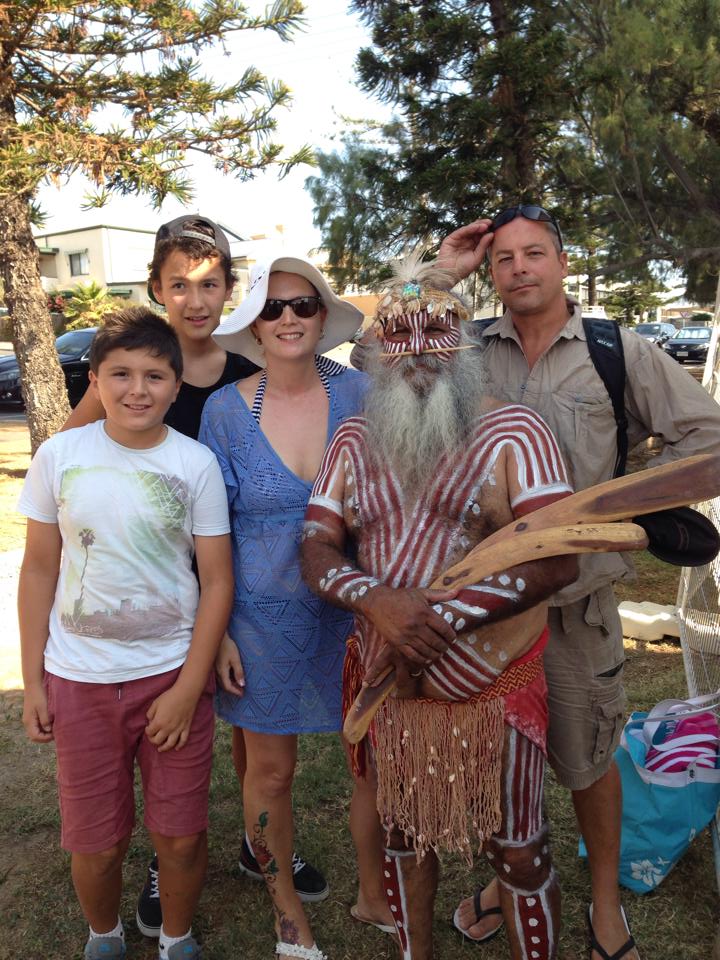
picture of my niece, elder Summer, Daniel, Nanton, Australia has always held a special place in my heart. Though it’s a 27-hour trip from Ottawa, I’ve been fortunate to walk on that beautiful land four times. Each visit has left a lasting impression. Yet, this particular journey was different. It was deeply personal, profoundly emotional, and soul-stirring in unexpected ways.
My husband, our son Andrew, and I traveled together to visit my late niece, Margaret Ann. I was also scheduled to speak at a conference. But, the time we spent together as a family is what has stayed with me most. The experiences we shared are unforgettable.
A Sacred Sanctuary and a Scenic Drive
A friend who now lives in Melbourne suggested we visit William Ricketts Sanctuary, nestled in the lush Dandenong Ranges. After a brunch of salmon omelets, lovingly prepared by my husband, we set off. Renting an apartment for our stay turned out to be a brilliant idea. On an earlier trip, we had stayed on a houseboat along the Murray River. That was another unforgettable experience.
The drive was serene and enchanting. Raised in Scotland, my husband had no trouble adjusting to the left-hand side of the road. Towering ferns lined the highway, creating a dreamlike landscape that whispered with the presence of something ancient and wise.
Though the sanctuary was inexplicably closed on a blue-sky day, we returned the next day. Along the way, we discovered Tea Leaves, a shop in Sassafras with over 300 varieties of tea and herbs. For a tea lover like me, it was heaven on earth. www.tealeaves.com.au
From Rainforest Wonder to Emotional Reckoning
Later, we visited the Melbourne Museum. We began in the rainforest exhibit, small but delightful, then watched Dinosaurs 3D at the IMAX — an awe-inspiring experience. But what moved us most deeply was the exhibition titled:
“I Am the Land: The Land is Me”
Link to exhibit →
This profoundly thought-provoking display centers on Australia’s Stolen Generations. Thousands of Aboriginal children were forcibly taken from their families between 1910 and the 1970s. This occurred under government-sanctioned assimilation policies. These children were placed in institutions or foster care, forbidden to speak their language or practice their culture. Many suffered abuse. Families were torn apart for generations.
Halfway through, I had to stop. I was overwhelmed. The grief in the room was palpable — ancestral, enduring.
My son Andrew sat on a bench next to a statue of two children being taken from their mother. He sat silently, his head in his hands. Seeing him there, next to those children, with the words of a grieving mother etched beside them, was heartbreaking.
I asked him what he was thinking. He looked up, tears in his eyes, and asked:
“How old were they when they were taken? Why?”
I had no answer that made sense of such injustice. All I say was: “It should never have happened.”
A Personal Echo of a Collective Pain
What I was feeling in that moment wasn’t only empathy — it was resonance. I am a survivor of Canada’s Indian Residential School system, where I spent seven years. My trauma met theirs in that space. And maybe Andrew, in his quiet sorrow, was feeling the inherited weight of intergenerational trauma.
In Canada, from the 1870s until 1996, more than 150,000 Indigenous children were taken from their homes. They were placed in residential schools. Most of these schools were run by churches under federal policy. These children, like those in Australia, were forbidden to speak their language or see their families. Thousands never returned. Abuse was rampant. The Truth and Reconciliation Commission later called it what it was: cultural genocide.
Grief Across Continents — and a Path Ahead
What struck me most was how pain is shared — across continents, across cultures, and across time. Though I stood on foreign soil, the story was achingly familiar. The systems were different, but the wound was the same.
And yet, there is power in witnessing. There is healing in remembering. There is dignity in telling the truth.
Our children need to know these stories. We need to hold space for the grief, and just as importantly, for the resilience. Because as Indigenous peoples — in Australia, in Canada, and around the world — we are still here. We are remembering. We are healing.


 From the Shores of the Ottawa River
Leave a comment