My extraordinary mama
“In every marriage, there is not only the joining of two people, but of two worlds — one visible, one spiritual.”
— Joseph Campbell
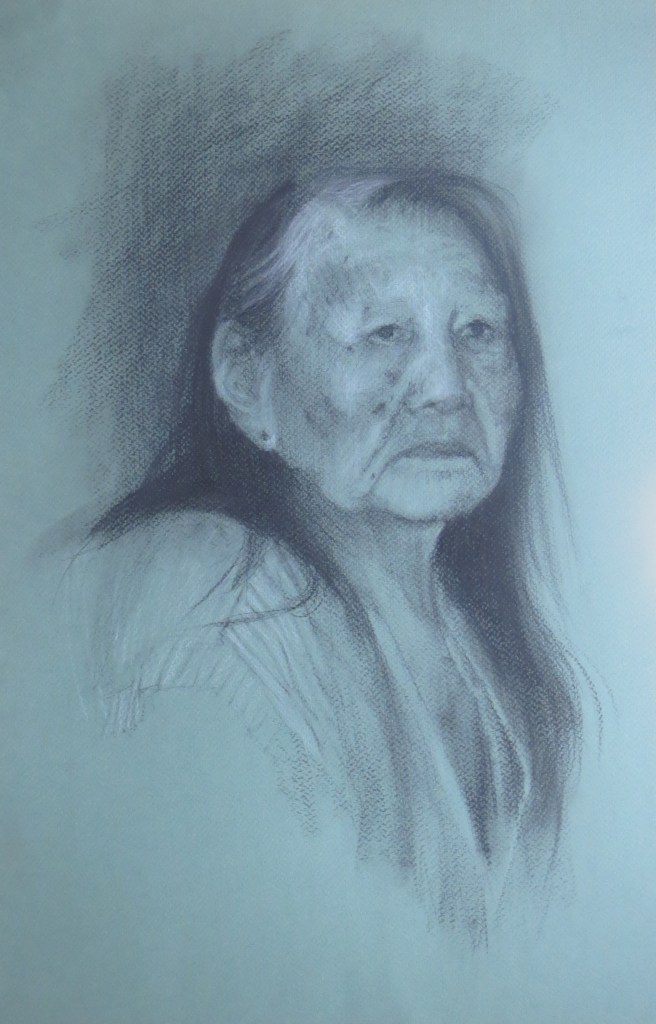
IMy mother, Therese Deranger (née Adams). She was the matriarch of our family. I also write about my father, Isidore Deranger. Their union was one of the last traditional Denesuline marriages of its kind.
Mama was born in Old Fort, Alberta, on May 8, 1919, the eldest of eleven children. She married my father by traditional custom in July 1933 at Fond du Lac, Saskatchewan. She had just turned fifteen. He was in his twenties. This was not unusual among the Denesuline, where marriages were unions of families, land, and survival.
Mama’s life bridged two worlds. One was the old way of life on the land. The other was the new world brought by settlement. She raised sixteen surviving children through decades of change, from dog teams to airplanes, from tents to modern homes. The word that best describes her is tenacious — she never gave up.
When I think of her life, I see a woman like Pocahontas. She is not the romanticized version, but the real one. She is strong, brave, and grounded in the realities of northern life. She lived through poverty, loss, and transformation. She raised us without running water or electricity, yet always kept a warm and welcoming home.
Mama once told me she had wanted to go to school, but my grandfather, Chris Adam, said no. Later, she would say that was a blessing — she escaped the fate of those taken to residential schools. Still, her desire to learn stayed with her. I remember her joy when she took an adult education course. She beamed as she wrote our names for the first time, her eyes shining with pride.
She was a teenage bride and a mother before sixteen. Her early years of marriage were hard. Sometimes, she ran away to her parents’ home, but each time her father brought her back to her husband. It was their way. She carried that resentment quietly all her life.
Mama gave birth to nineteen children, most delivered without doctors or hospitals. Once, in early March, she walked ten miles through snow. She did this to reach a midwife’s home. She needed to give birth to my brother. Today, births happen surrounded by medical teams, technology, and comfort. But Mama’s generation understood birth as a natural ceremony — something sacred and enduring. Her strength came from her deep connection to nature and trust in the women who guided her.
She endured more than her share of hardship. I once asked why she hated the sound of the wind. She told me it reminded her of being alone in a tent with her children. They were sick and feverish. Her eardrums burst from the pressure. Another time, she lost a baby in the cold of winter, only two weeks old. Her grief was immense, but she kept going.
In her thirties, she survived breast cancer and eleven surgeries, always returning home to her children. She was hospitalized once. She told us she saw a man surrounded by light at the foot of her bed. She prayed, asking him not to take her yet because her children still needed her. She lived another forty years.
There were difficult times during the sixties and seventies, but she overcame them with determination. One day she simply decided — no more drinking, no more smoking — and that was that. Her will was iron. She gave her all to us.
Mama’s life was not just struggle. She found joy in travel, family, and prayer. Her beadwork was exquisite — delicate caribou-hide jackets and moccasins adorned with roses. She would scold me for using long threads, saying, “Don’t be lazy, make your thread shorter.” She was right — shorter threads meant patience and perfection.
She was known across the north for her skill and generosity. Every summer, she traveled to the Lac Ste. Anne Pilgrimage, Canada’s largest Indigenous healing gathering. She loved reconnecting with family and friends there. She always returned with bottles of holy water and medals to give as gifts.
Her bread pudding at Christmas was famous, and in summer she baked bannock on the wood stove outside. She found happiness in small things — family laughter, clean floors, good bread, and prayer.
In my twenties, I took the Forum course with Landmark Education. It changed my life and my relationship with my mother. I realized I had been holding her to expectations she never promised to fulfill. When I chose to accept her as she was — not who I thought she should be — everything changed.
I saw that she gave me everything she had. Her mother gave her everything she had. And now, as a parent, I give my children all I have — holding nothing back. That is the legacy she left us.
Mama’s love was vast, even when unspoken. Parents of her generation didn’t say “I love you,” but they showed it through their actions. She was the rock that held us through poverty, loss, and change.
She passed away on February 11, 2016, in Fort McMurray, Alberta, at the age of ninety-six. She was remembered in the Fort McMurray Today newspaper as “the last traditionally raised, nomadic Denesuline woman.”
I’ve come to see everything she did as an act of love. You can discover that, too, with your parents. Remember their eyes, their love, their courage. Carry that with you when your heart feels heavy. You have the power to see them as they were — human, imperfect, and giving everything they had.A Daughter’s Revelation
Through that course, I came to discover something profound: she had given me everything she had. Her mother had given her everything she had. And now, as a mother myself, I give everything I have. None of us held anything back.
That realization healed something inside me. I chose to accept her for who she was—not who I wanted her to be. From that moment, my heart softened. I saw the vastness of her love, even when it was unspoken. Her strength, her faith, her endurance—they were all expressions of love.
You can discover that, too, with your own parents. Remember their eyes, their love, and their courage. Carry that memory when your heart feels heavy. Forgive what you must. See them as human—imperfect but giving everything they had.
She gave me strength. She gave me life. And through her, I learned the power of never giving up.


 From the Shores of the Ottawa River
Leave a reply to toblogtoday Cancel reply